As part of a recent early Shinji Hosoe kick, I decided to pick up Attack of the Zolgear since it was cheap on Mercari. Hey, what's that say at the top?
GALAXIAN³
Huh. I guess "Attack of the Zolgear" is some sort of Galaxian sequel?
Oh.
Oh no.
Welp, strap in cause I guess we're going down this rabbit hole now.
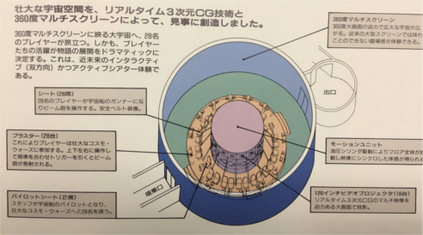
The original Galaxian³: Project Dragoon was an attraction at Expo '90 in Osaka, a 28-player rail shooter played in a 360-degree theater. Aside from that ridiculous sentence I just wrote, the game was also incredibly graphically ambitious, utilizing video streamed from a LaserDisc interlaced with top of the line 3D graphics. Namco's goal at this international expo was to create a Hollywood sci-fi cinematic experience complete with English voice overs and CD-quality music from Shinji Hosoe, Ayako Saso, and Takayuki Aihara. Seriously, look at some gameplay footage of it. It's insane that it existed at the time that it did. Bubble economy Japan ftw.
Soon after Namco tried to develop a single-player version for arcades, but this was scrapped and eventually became an original game called Starblade. Starblade was perhaps the biggest hit of all the games I'll be talking about and was a huge influence on the budding 3D shmup genre, paving the way for the likes of Star Fox and Panzer Dragoon. The music in this one was handled solely by Hosoe, though there isn't much of it (only 4 tracks). The soundtracks to both Starblade and the original Galaxian³ were included on Namco Sound Express Vol. 6. An interesting thing about this album is that the liner notes for each are written upside-down relative to each other so that both read left-to-right and either can be made the cover image, though the popular Starblade is what customers saw first before opening it.
Meanwhile Namco was still wondering what else they could do with the original Galaxian³. A massive 28-player theater-sized arcade cabinet was obviously too cumbersome to install anywhere sane. So they relocated the original machine to their theme park in Tokyo (yes, Namco had their own theme park called Wonder Eggs) and produced two scaled-down versions for arcades, the GM-16 (16 players) followed by the Theater 6 (6 players). With the latter came new music from Hosoe and Saso, including some reused and rearranged from Starblade, all of which can be found on Namco Sound Express Vol. 12.
Unfortunately, even the more compact versions of the game still took up a lot of space and once interest in the game dwindled arcade owners were all too eager to scrap them for parts and make room for new games. As a result the machines are now incredibly rare and the subject of preservation efforts.
This also offers a potential explanation to why Starblade ended up being the real hero of this story; as a single player cabinet it was surely more economical to install and maintain in smaller arcades and shops than its larger multiplayer brothers and likely reached a wider audience because of this.
The epilogue to this saga comes in 1994 when Namco released a sequel called Attack of the Zolgear, which is how I found myself in this mess. It ran on a modified Theater 6 from the smaller arcade version of Galaxian³, this time packing not just one but two LaserDiscs. Hosoe and Saso returned once again for the music, joined by relative Namco newcomer Nobuyoshi Sano (sanodg), though it seems his main role was sound effects. The soundtrack to this one is on Namco Sound Express Vol. 16.
My overall impression of the music is quite good (obviously, or I wouldn't have gotten balls-deep into it) but most of the tracks are rather short and so are best heard together as full album experiences rather than individually. The same could also be said of the albums themselves, as each volume is only about 20-30 minutes long without the narration tracks, meaning you could comfortably listen to all three in one sitting. I wouldn't be put off by their short length though since they were cheap on release (¥1500) and are even cheaper now. I don't think I have to go too much into Hosoe himself since pretty much anyone familiar with VGM should know the guy and his style. The stuff here leans strongly on the jazz fusion side, heavy on spacey synths and strong basslines. If you're a fan of his work on Ridge Racer or Dragon Saber I don't think you can go wrong here.
Diagram of the 28-player Expo '90 version:
Footage from the 28-player version (video title is wrong):
https://youtu.be/n7sL2pJ34vg
Footage from the 6-player arcade version:
https://youtu.be/xngRAh7L6Ak